
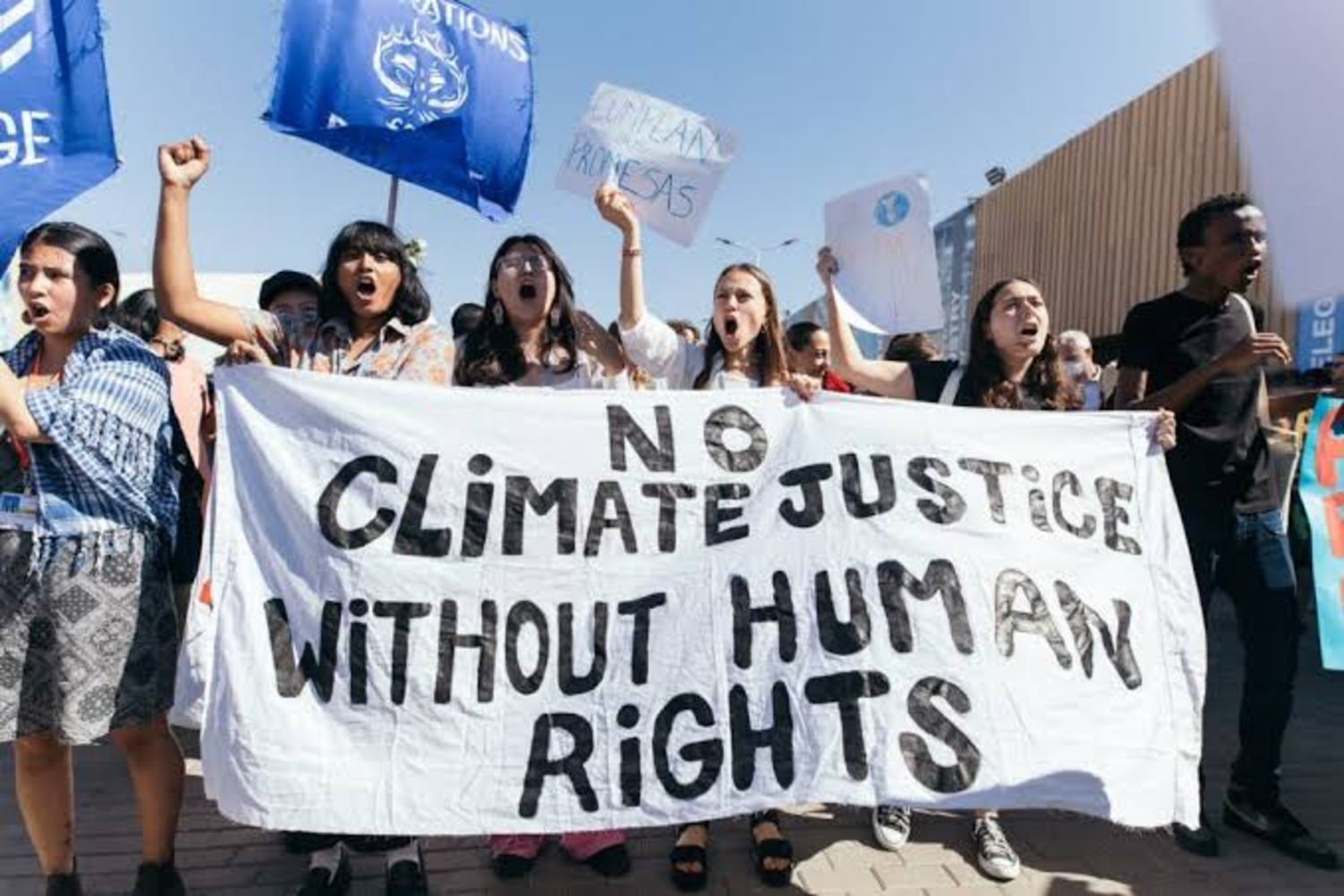
1.0. Introduction - Framing the Conversation
On a sweltering day in southern Europe last summer, an elderly woman sat by her window,
clutching a damp cloth to her face.
The heat had risen beyond what her body could bear. Across the world, in a coastal town in
Southeast Asia, a fisherman
watched as rising tides swallowed the last of his shoreline, the same beach where his father
once moored his boat.
Thousands of miles away, in the parched plains of East Africa, a young girl trekked farther
than ever to find water,
her school attendance now replaced by the daily search for survival.
These are not disconnected events. They are fragments of one global story, a story of climate change that transcends geography and wealth, touching every corner of human existence. It is the story of homes lost, dreams interrupted, and lives redefined by forces far beyond individual control. And while science provides us with data, such as rising temperatures, melting glaciers, and displaced populations, it is the human faces behind those numbers that reveal what’s truly at stake. Climate change is not just an environmental crisis; it is a moral one as well. It determines who eats and who starves, who stays and who is forced to flee. It decides whose voices are heard and whose suffering remains unseen. This is why the conversation can no longer rest solely on emissions charts or economic forecasts; it must include justice, dignity, and rights.
The idea of climate justice emerged from this realization. It asks a simple but urgent question: Who bears the burden of a warming planet, and who holds the power to change it? It shifts the lens from abstract environmental targets to the lived experiences of communities, especially those least responsible yet most affected. It reminds us that fairness, not just efficiency, must guide our climate actions. But as the movement for climate justice grows, it also calls for deeper grounding, one that connects moral urgency with legal accountability. Because beyond moral appeals lies a framework that gives these demands structure and force: human rights. The recognition that access to clean air, safe water, food, and shelter are not privileges, but fundamental rights, transforms climate action from charity into obligation.
In this way, understanding climate change through the lens of human rights isn’t just about redefining the problem, it’s about reimagining responsibility. It’s about affirming that the right to a livable planet is a universal promise, one that transcends borders and generations.
2.0. The Evolution of Climate Justice
The term climate justice didn’t begin in boardrooms or UN conferences; it was born from the
cries and courage of communities on the margins. Long before the world began using the
language of carbon budgets and mitigation targets, people in the Global South, Indigenous
groups, and frontline communities were already living the realities of environmental
inequality. They were the first to say: this isn’t just about weather, it’s about justice.
In the 1980s and 1990s, environmental movements across the United States and the Global South began connecting pollution, poverty, and power. Activists noticed a pattern: the people who contributed least to environmental harm were suffering the most from its consequences. Toxic waste dumps were placed near poor and minority neighbourhoods. Deforestation pushed Indigenous families off ancestral lands. Floods and droughts erased generations of effort in regions already struggling for stability. It was in this convergence of inequality and ecology that the phrase “environmental justice” first took root, a movement that later expanded to encompass global climate change, giving birth to what we now call climate justice.
By the early 2000s, the phrase had entered international discourse. From the streets of Copenhagen to the corridors of the United Nations, activists demanded that climate policy acknowledge history, especially the uneven legacy of industrialization. The argument was simple yet profound: those who benefited from centuries of carbon emissions must carry greater responsibility for addressing their consequences. It was no longer enough to reduce emissions; fairness and accountability had to be part of the equation.
Over time, climate justice became a rallying call that reframed climate change not as a distant scientific issue, but as an everyday question of equity, human rights, and survival. It emphasized that the global climate crisis is intertwined with social systems, poverty, gender, race, and colonial history all shape who is most at risk. It’s why a flood in Bangladesh is not just a natural disaster; it’s a reflection of global inequality. It’s why drought in the Sahel is not just about rainfall, but about decades of economic marginalization.
What began as grassroots resistance evolved into a global moral compass. The climate justice movement reshaped the conversation, from “how do we fix the planet?” to “how do we protect people and uphold their rights while doing so?” This shift brought empathy and ethics into the heart of climate discourse. And yet, while moral appeals have galvanized public attention, they often face limits when confronting entrenched systems of power. Justice demands more than compassion; it requires accountability. It demands frameworks that can compel action, not just inspire it.
3.0. The Human Rights Dimension: Legal Foundations of Climate Justice
Exploring the nuances of human rights law, it is pertinent to discuss the significant
recognition given to the implementation of fair and just climate actions. In upholding
environmental rights, climate justice maintains a firm stance and cannot be overlooked or
ignored. Although the law aims to protect individual and collective rights, the same must be
done in respect to climate change issues, diligently pursuing every corner to fully address
the negative impacts of climate change on vulnerable communities. In view of this, various
national and international organizations have effected their legal and regulatory frameworks
to reflect the existence of climate rights, with defined duties and obligations for
enforcing climate justice.
Human rights law provides a foundation for climate justice, as it is recognised as a subject
of concern alongside other human rights issues. In reality, climate change has negative
impacts on the enjoyment of human rights such as the right to life, food, health,
development and lots more. These impacts are a consequence of human activities which do not
necessarily emerge from all classes of persons. This points to the fact that the major
contributing parties to climate change suffer less havoc compared to persons whose way of
life barely affects the climate's existence. Thus, climate justice needs to be done and also
seen to be done. Various international legal instruments purport to uphold climate justice
via prohibitory and obligatory provisions. The Universal Declaration of Human Rights (UDHR),
International Covenant on Civil and Political Rights (ICCPR) and the International Covenant
on Economic, Social and Cultural Rights
(ICESCR), do not directly refer to climate justice. However, their scope has been positively
expanded to include climate and environmental rights in the protection of other fundamental
rights.
Distinct from the foremost-mentioned treaties, the African Charter on Human and Peoples’
Rights (ACHPR)
explicitly provides for a general satisfactory environment for all persons, favorable to
their development.[1]
This provision appears to be one of the most potent human rights foundations for climate
justice in Africa,
and has been exemplified in the landmark case of SERAC v. Nigeria[2], where the
African Commission on Human and Peoples’
Rights ruled against Nigeria for violating the rights of the Ogoni people in relation to
their property, health and a satisfactory environment.
Although the African Commission had successfully recognized environmental rights in light of
human rights law, the non-binding nature of its
judgment makes a mockery of its existence. Similarly, major international legal structures
that tend to directly address climate issues usually
maintain their persuasive nature, as their decisions remain non-legally binding. A
significant example is the Advisory Opinion on the Obligations
of States with Respect to Climate Change[3], consolidated by judges of the
International Court of Justice. This advisory opinion, delivered on
July 23, 2025, affords a certain level of confidence in the applicability of human rights
law in combating climate change. However, it remains
an advisory paper and has no binding force whatsoever.
Examining the United Nations Framework Convention on Climate Change (UNFCCC), it is safe to state that climate change threatens the enjoyment of fundamental human rights, and it is based on this reason that the United Nations decided to address climate issues with the enactment of this distinct convention. Additionally, these legal instruments foster climate advocacy, giving room for questioning climate injustice and environmental rights infringements. Delving into case studies, one of the foremost judicial pronouncements on climate justice is the landmark case of Urgenda Foundation v. Netherlands[4], where the Dutch Supreme Court ruled that the government of the Netherlands had failed in its human rights obligation to protect its citizens against climate change. This decision marks the beginning of the climate litigation movement around the globe, and is often referred to as the “world’s first climate liability suit”.
4.0. Power, Inequality, and Responsibility
Every time the world gathers to discuss climate change, from the grand halls of COP meetings
to quiet community dialogues, one question lingers in the air: Who should bear the cost of
healing the planet?
The answer, though morally clear, has always been politically complicated. The climate crisis is not a story that began equally for everyone. Its roots trace back to centuries of industrial growth, colonial extraction, and the relentless pursuit of profit that powered the Global North while draining resources from the Global South. For generations, nations that now face the harshest effects of climate change were also those whose lands, labor, and raw materials fueled the prosperity of others.
When we speak of responsibility, therefore, we are not speaking of guilt; we are speaking of history. The factories that once drove progress in Europe and North America also filled the skies with carbon that now traps heat across the world. Meanwhile, regions like sub-Saharan Africa or small island states, whose carbon footprints remain negligible, are battling the rising seas, heat waves, and droughts that threaten their very survival.
This imbalance gave rise to one of the most important principles in global environmental governance: common but differentiated responsibilities. It recognizes that while all nations share the duty to protect the planet, not all bear equal blame for its degradation, and therefore, not all should be expected to act in the same way or at the same pace. This principle captures the moral and political heart of climate justice: fairness must guide our collective response.
Yet global power dynamics continue to shape who gets to decide what “fairness” looks like. Wealthier countries often pledge support but fall short on delivery, while poorer nations are urged to transition away from fossil fuels without sufficient funding for renewable alternatives. It is, in many ways, an unequal negotiation, one where those least responsible are expected to do the most with the least.
But inequality doesn’t stop at borders. It runs through the fabric of societies. Within countries, women, youth, and low-income groups bear disproportionate burdens. A flood may affect a whole city, but it is often women who wade through the aftermath, caring for displaced families, salvaging food, and rebuilding livelihoods. Studies show that climate-induced disasters deepen existing gender gaps, pushing vulnerable communities further into hardship. This is why climate justice cannot be separated from social justice. It is about dismantling the power structures, both global and local, that decide whose pain is recognized and whose is ignored. It is about ensuring that the transition to a green economy doesn’t repeat the same hierarchies that caused the crisis in the first place.
And amid all this, accountability becomes essential. Because promises mean little without systems that ensure follow-through. While activists and communities continue to demand equity in moral terms, a growing movement of legal thinkers is transforming these moral expectations into enforceable commitments. Still, beyond laws and negotiations lies a deeper truth: justice is not charity; it is balance restored. Climate justice reminds us that responsibility is not merely about who caused the problem, but about who chooses to act now to fix it. True leadership in the age of climate change is measured not by wealth or power, but by willingness to act for others.
5.0. Legal Pathways for Climate Justice
Practically, climate justice requires certain legal steps in order to achieve significant
feats. It involves the utilization of laws, climate policies and legal systems to ensure
accountability and fairness in addressing climate change. Although the legal systems of
countries may differ, accountability remains an objective for all, achievable through
climate litigation, human rights commissions, recognition of ecocide, and youth petitions,
among others. Climate litigation, on the one hand, involves the institution of lawsuits in
competent courts of jurisdiction to enforce certain climate rights that might have been
violated by individuals or state parties. Over the years, this legal pathway has been proven
effective and properly recognized in various jurisdictions around the world. Examples
include the landmark cases of Urgenda Foundation v. Netherlands (supra) and Leghari v.
Pakistan.[5]
Inclusively, some legal systems are pushing for the recognition of ecocide as an international crime. This implies that governments and corporate bodies will be criminally accountable for environmental and climate harm. While many countries have been reluctant to recognise this concept, other countries, including Russia, France, Ukraine and Belgium, have incorporated ecocide into their law, setting precedents for environmental accountability.
It is also necessary to emphasize the potency of youth petitions and activism in the movement for climate justice. Young people and youth organizations demand accountability from their leaders in respect of their climate obligations through the use of legal and policy channels. For instance, in Africa, the African Youth Initiative on Climate Change (AYICC) remains instrumental in ensuring that the youths within the continent have a voice in climate actions and policies. Interestingly, national and international human rights institutions are consistently handling climate injustice as a violation of fundamental rights. For example, the UN Human Rights Council, in a resolution reached in 2016, admonished state parties to incorporate human rights in climate actions.[6] Also, the African Commission on Human and Peoples’ Rights, as earlier stated, provides an avenue for aggrieved persons or organizations to legally protest their climate concerns and get appropriate remedies in the enforcement of climate justice. Although certain circumstances might temporarily hinder these pathways, their influence on climate justice remains commendable and cannot be overlooked.
6.0. Human Rights–Based Climate Action: Policy and Advocacy
If climate justice begins with empathy, it must end with action, action that protects both
people and the planet. A human rights–based approach to climate change offers a moral
compass for that journey. It shifts the focus from abstract policy debates to the lived
experiences of those most affected, ensuring that solutions are not just effective, but
fair.
At its core, this approach recognizes that the right to life, health, food, water, housing, and participation are all intertwined with the environment. When these rights are threatened by floods, droughts, or rising seas, climate change becomes a human rights crisis. And when governments and institutions act through this lens, climate policies move from being optional choices to moral obligations.
We see glimpses of this transformation across the world. In 2021, the United Nations Human Rights Council declared access to a clean, healthy, and sustainable environment a universal human right, a landmark moment that reframed climate action as a duty owed to every individual, not a favor granted by powerful nations. Some countries, such as Costa Rica and Sweden, have already embedded environmental rights into their constitutions, giving citizens a legal pathway to hold governments accountable. In other places, grassroots organizations are bridging the gap between policy and people, translating global principles into community-driven action.
For instance, in Pacific Island nations threatened by rising seas, youth movements have
mobilized to demand climate education and relocation plans that protect cultural heritage.
Across Africa and Latin America, women-led cooperatives are championing renewable energy
projects that power rural communities while promoting economic inclusion. These efforts
remind us that climate justice is not only achieved through courtrooms or negotiations, but
through everyday acts of advocacy, where people insist that dignity and survival are
non-negotiable.
A human rights lens also reshapes how policymakers design and evaluate climate interventions. Instead of focusing solely on emissions numbers, it asks: Who benefits from these policies? Who might be left behind? By centering participation, transparency, and accountability, this approach ensures that climate action strengthens democracy rather than bypassing it. It compels decision-makers to consult those on the frontlines, farmers, fisherfolk, and Indigenous leaders not as victims, but as experts of their own realities.
Education and storytelling play a vital role, too. The more people understand that climate change is not a distant scientific issue but a direct threat to their rights, the stronger collective action becomes. When communities see climate policy as a pathway to secure their right to health, food, and safety, engagement deepens. And when governments recognize citizens as partners rather than passive recipients, resilience grows. Still, challenges remain. Many human rights frameworks rely on voluntary commitments, and global inequities persist. But even in the face of slow progress, this approach offers hope, because it transforms the fight against climate change into something deeply personal and profoundly universal. It reminds us that justice is not abstract; it lives in clean air, safe homes, and the right to build a future free from fear. By rooting climate action in human rights, we align environmental goals with the essence of humanity itself. And that alignment, between moral principle and public policy, is where real transformation begins.
7.0. Conclusion: Reimagining Justice in the Age of Climate Change
In the end, climate justice is about more than emissions or economics; it’s about what kind
of world we choose to build together. It asks us to look beyond charts and treaties and see
people: the child forced from her home by rising floods, the farmer watching his crops
wither under unfamiliar heat, the coastal families rebuilding again and again after storms
that grow stronger each year. These are not isolated tragedies; they are the moral pulse of
our time. We stand at a crossroads where technology, policy, and morality must finally
align. The science of climate change tells us what is happening; the language of human
rights tells us why it matters. Together, they form the blueprint for a just and sustainable
future, one in which progress is measured not only by GDP or emissions reductions, but by
lives protected and communities restored.
If we are to reimagine justice in this age of climate uncertainty, we must begin by redefining what responsibility means. It is no longer enough to act out of fear or guilt; we must act out of solidarity. Climate justice calls for a shared awakening, an understanding that the atmosphere does not recognize borders, and neither should our empathy. The suffering of one community is, in truth, a warning to all of us. But this story does not end in despair. Across continents, people are rewriting what justice looks like, through litigation, through advocacy, through collective courage. From youth activists demanding a liveable future to small communities designing their own climate adaptation plans, ordinary people are proving that justice is not an abstract concept; it’s a daily practice of care and accountability.
Human rights frameworks give this moral will a durable structure. They transform compassion into commitment. They remind governments that their duty is not merely to regulate the environment, but to protect the people who depend on it. And they remind each of us that protecting the planet is not an act of generosity, it’s an act of justice. So perhaps the real question is not whether we can achieve climate justice, but whether we are willing to see ourselves as part of it. The answer will define not only our policies, but our humanity. Because in the age of climate change, justice is no longer something to be demanded from others; it’s something we must live together.
References
[1]Article 24
[2]Communication No. 155/96] (2001) ACHPR 35 (27 October 2001)
[3] Obligations of States in Respect of Climate Change (Advisory Opinion) [2025]
ICJ Rep.
https://icj-web.leman.un-icc.cloud/sites/default/files/case-related/187/187-20250723-adv-01-00-en.pdf
(accessed on 11/11/2025)
[4] ECLI: NL: RBDHA: 2015: 7145 (Official Case No)
[5]Lahore High Court, Asghar Leghari v. Pakistan, Case W.P. No. 25501/2015, Judgement of 25 January 2018.
[6]Resolution 32/33 (July 2016), Human Rights Council resolutions on human rights
and climate change.
https://www.ohchr.org/en/climate-change/human-rights-council-resolutions-human-rights-and-climate-change
(accessed on 11/11/2025)